Most olfactory products put together someone else’s sensor, someone else’s instrument and someone else’s model. ADVENT makes all four layers itself — the graphene sensing material, the multisensor chip, the Mk.2E instrument and the on-device AI. That is what lets us change the chemistry and the model together when the target changes.
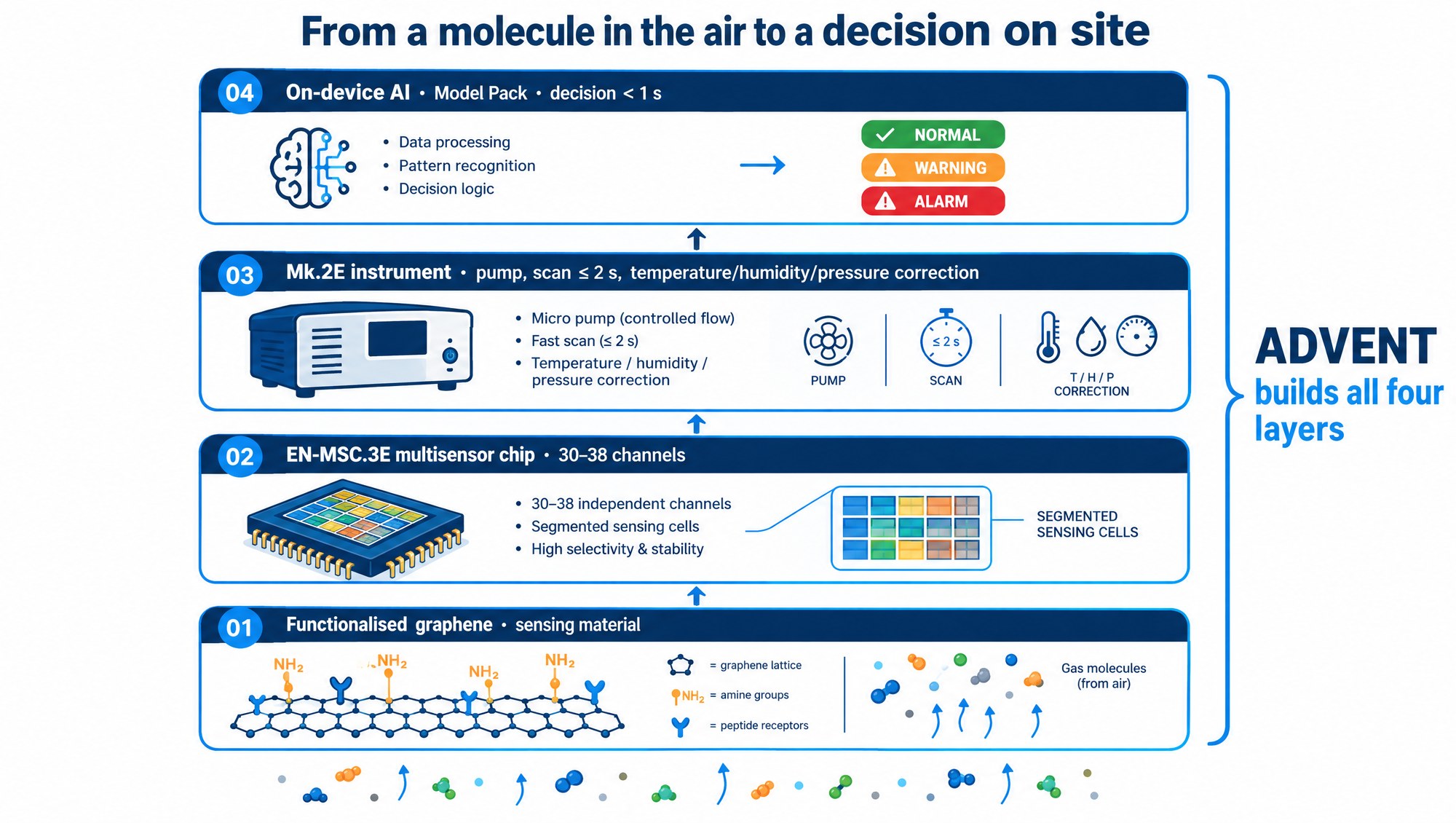
Each layer hands the next one something more useful: a surface that reacts, a chip that turns the reaction into a vector, an instrument that keeps the vector comparable, and a model that turns it into a decision.
Aminated graphene carrying recognition peptides, as disclosed in our granted patents. Every sensing cell is functionalised differently, so one mixture lands differently on each cell — and that spread between cells is the signal. Graphene’s large surface area and electrical sensitivity give trace-level detection.
30 to 38 chemiresistive channels on one replaceable chip. A gas molecule that adsorbs on the surface shifts each channel’s resistance by a different amount, so one exposure produces a response vector rather than a single value. A micro-heater restores the surface for the next reading.
A built-in pump draws the sample, every channel is scanned in two seconds or less, and the response is corrected for temperature, humidity and pressure and compensated for drift. Continuous watch runs in a low-temperature mode; high temperature is an intermittent regeneration step.
The corrected vector becomes an odour fingerprint. Pre-processing, PCA, LDA and SVM classify it against the Model Pack loaded for that site — on the instrument, in under a second. No GPU, no cloud; only the result leaves the site.
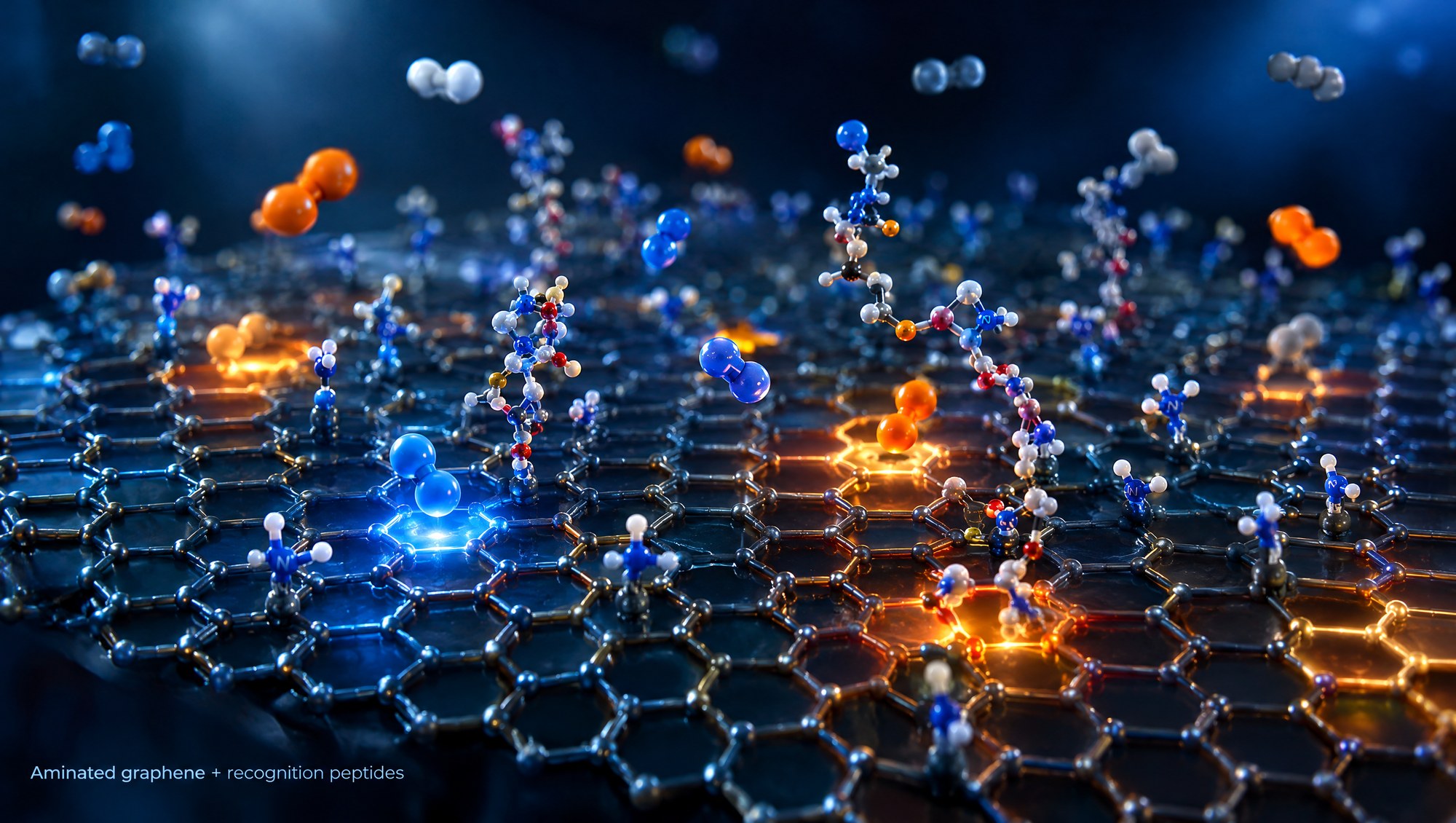
Illustration of aminated graphene with recognition peptides. Rendered to explain the principle, not a micrograph.
Hardware produces the fingerprint. Everything between that fingerprint and an operator acting on it is software — and software is where a new application area is actually added.
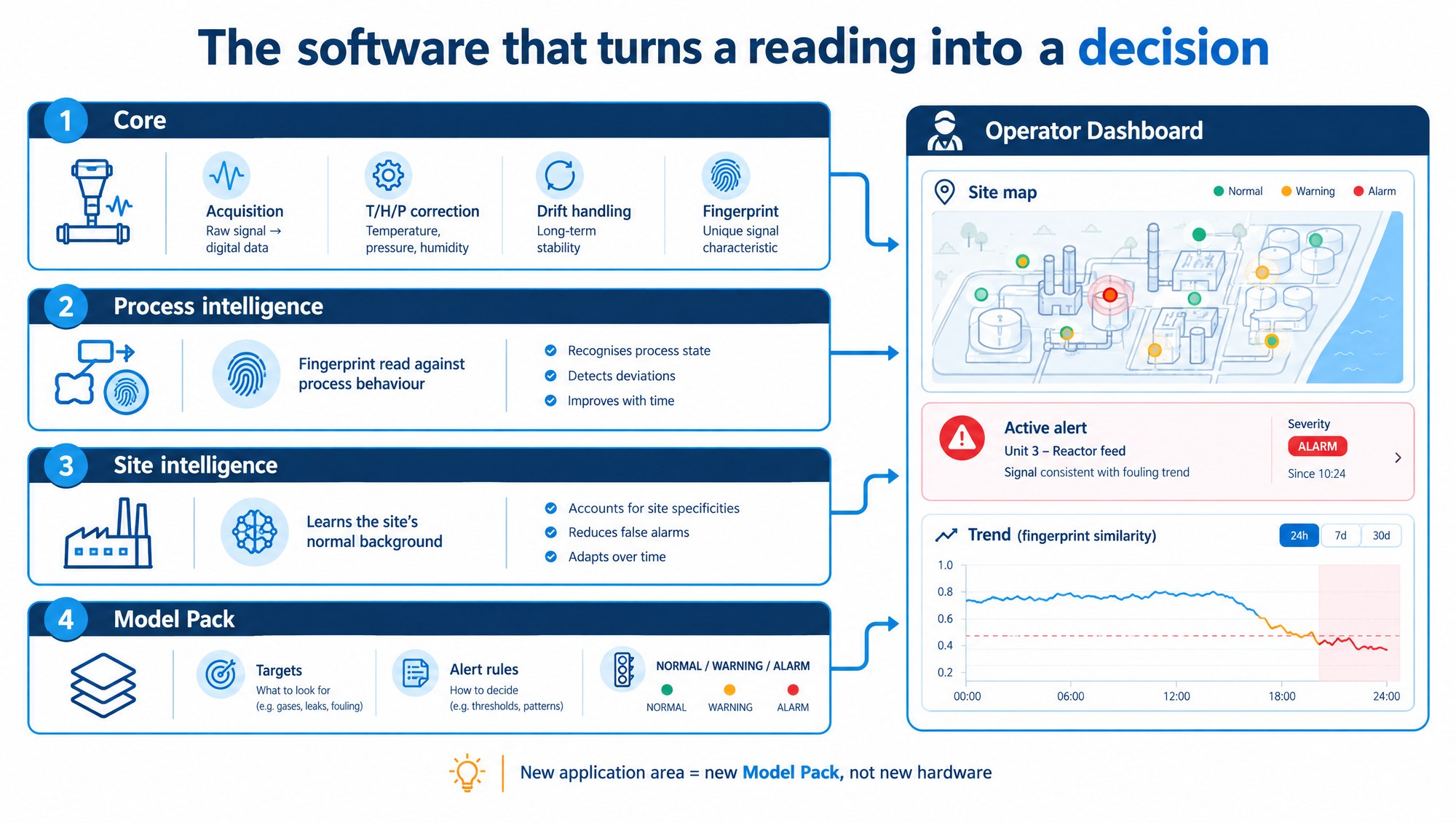
Acquisition, temperature–humidity–pressure correction, drift handling and the fingerprint itself. It keeps two readings comparable across batches, sites and seasons.
Reads the fingerprint alongside what the process was doing at the time, so a change is interpreted in context rather than in isolation.
Learns the ordinary chemical background of one location. One site’s normal is not another’s, and most false alarms come from ignoring that.
The question the instrument answers at this site: which targets, which alert rules, when to move from NORMAL to WARNING to ALARM. A new area means a new pack, not a new machine.
Classifier parameters, the feature-engineering recipe, electrode geometry, measurement-circuit specifications and material synthesis conditions are not disclosed on this site. They are shared under NDA with partners running a technical evaluation. What is public: the patent-disclosed material, the recognition pipeline (PCA · LDA · SVM) and the confirmed Mk.2E specification.

We give AI the sense of smell.
GraphAISense is the product brand. ADVENT is the maker.
Headquarters #909, 28 Digital-ro 33-gil, Guro-gu, Seoul
R&D Center #420, 237 Yangji-ro, Sosa-gu, Bucheon-si, Gyeonggi-do
Plant 144-6, 3·1manse-ro 281beon-gil, Jangan-myeon, Hwaseong-si, Gyeonggi-do
ADVENT USA · US sales 8 The Green #22818, Dover, DE 19901, USA
Business registration 522-81-03199 · CEO Choi Chang-hee
Performance figures are ADVENT’s own verification results under the stated conditions; they are not accredited third-party certificates and must not be generalized as overall accuracy.
GraphAISense is a complementary monitoring channel. It does not replace statutory fire protection systems, legally mandated measuring instruments, or a battery management system.
Healthcare and care applications are at research stage. GraphAISense is not a diagnostic product.