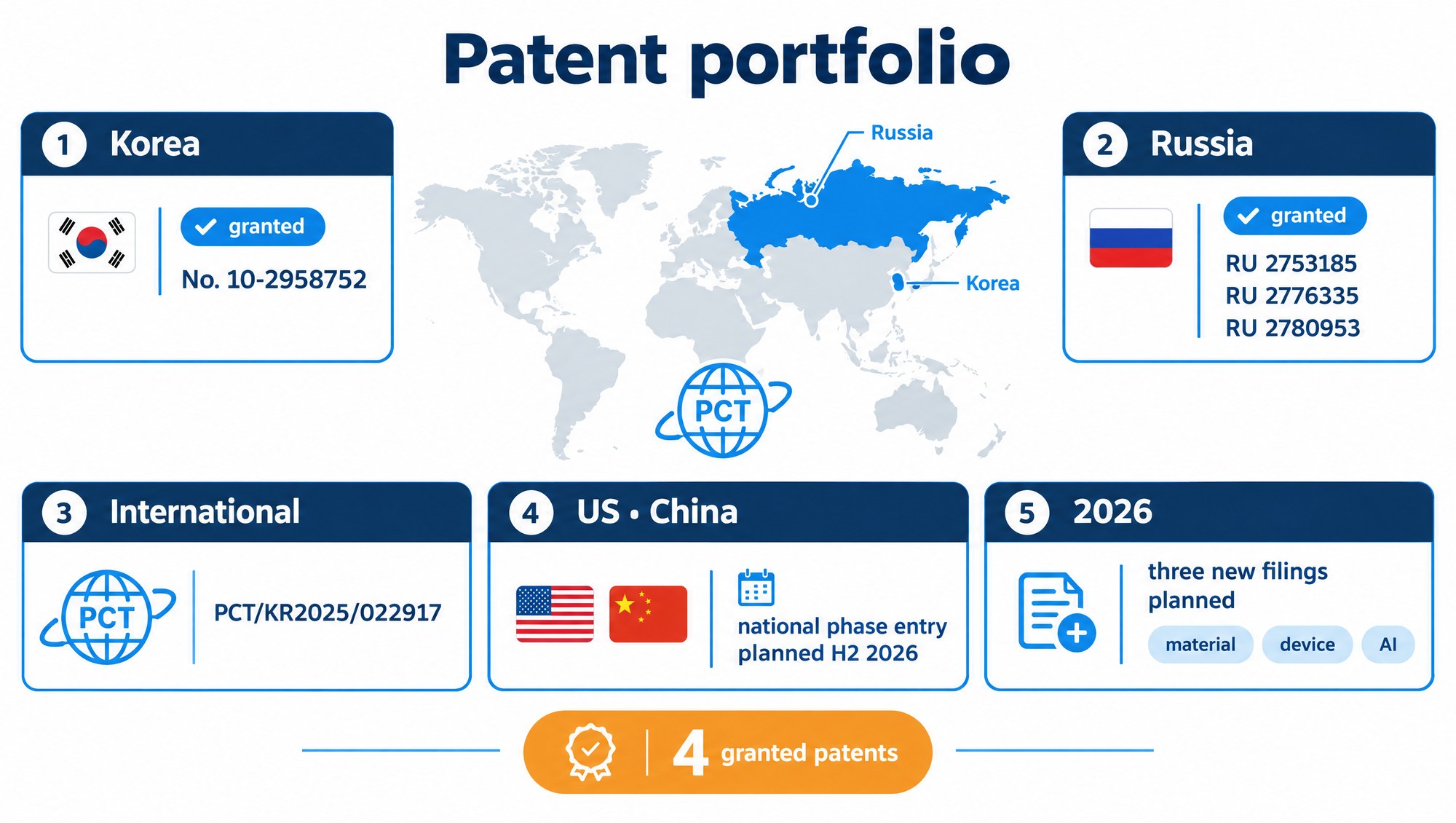
The patent estate follows the product: the sensing material, the multisensor chip and the system that reads them. Everything on this site comes from published patent material or the confirmed Mk.2E specification. The rest is held under NDA.
We publish enough for an engineer to judge whether the approach suits their chemistry. What turns that approach into a working Model Pack stays with partners under agreement.
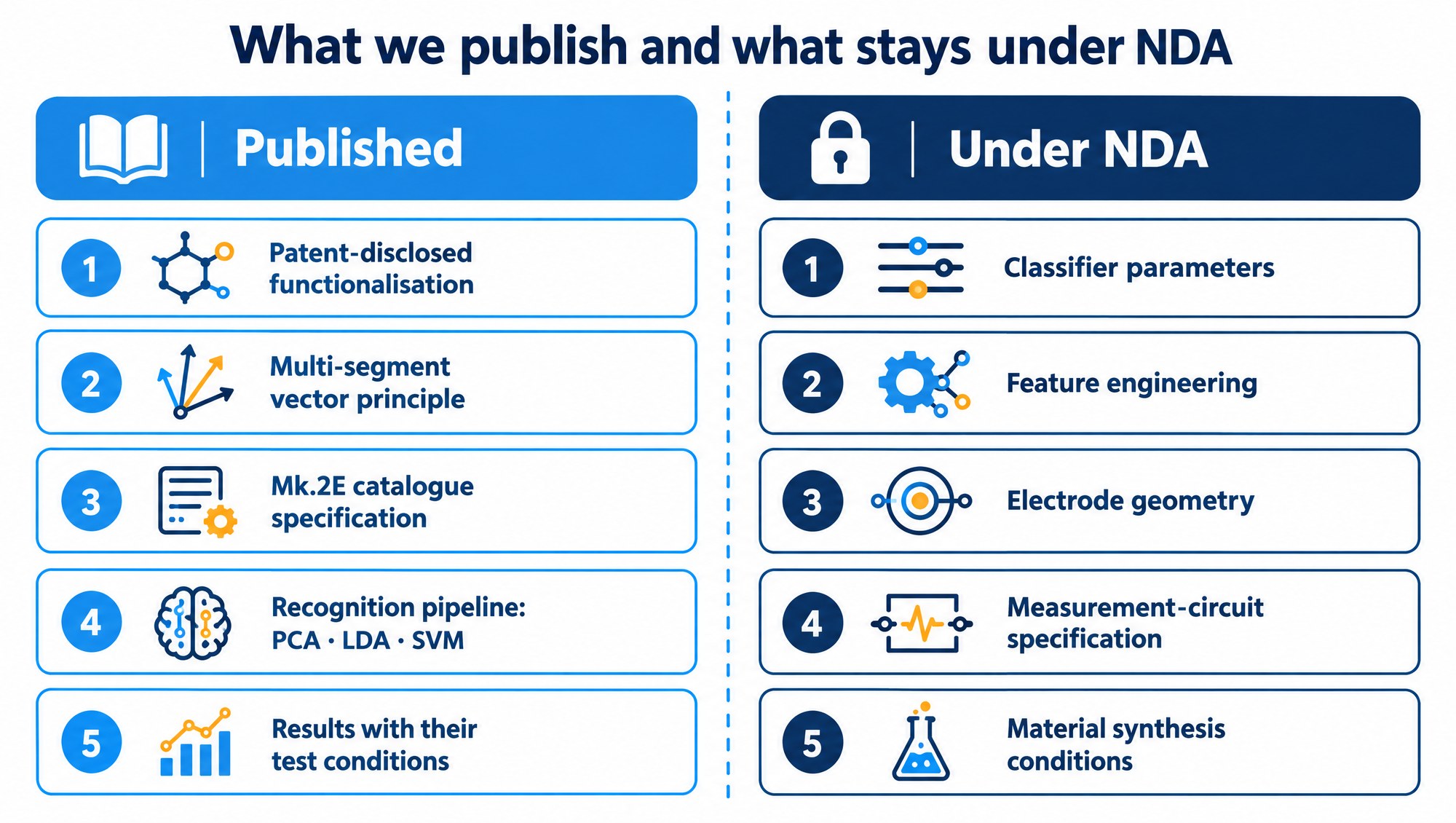
The functionalisation approach disclosed in our granted patents — aminated graphene with recognition peptides. The multi-segment vector principle. The recognition pipeline (pre-processing, PCA, LDA, SVM). The confirmed Mk.2E specification, and verification results with their conditions.
Classifier parameters and hyperparameters. The feature-engineering recipe. Electrode geometry. Measurement-circuit specifications. Material synthesis conditions. Shared with partners running a technical evaluation, under agreement.

We give AI the sense of smell.
GraphAISense is the product brand. ADVENT is the maker.
Headquarters #909, 28 Digital-ro 33-gil, Guro-gu, Seoul
R&D Center #420, 237 Yangji-ro, Sosa-gu, Bucheon-si, Gyeonggi-do
Plant 144-6, 3·1manse-ro 281beon-gil, Jangan-myeon, Hwaseong-si, Gyeonggi-do
ADVENT USA · US sales 8 The Green #22818, Dover, DE 19901, USA
Business registration 522-81-03199 · CEO Choi Chang-hee
Performance figures are ADVENT’s own verification results under the stated conditions; they are not accredited third-party certificates and must not be generalized as overall accuracy.
GraphAISense is a complementary monitoring channel. It does not replace statutory fire protection systems, legally mandated measuring instruments, or a battery management system.
Healthcare and care applications are at research stage. GraphAISense is not a diagnostic product.