Written when something actually moves in product, technology, the field or partnerships. Corporate, IR, certification and recruitment notices are in Announcements.
Under an agreement signed on 30 October 2026, GraphAISense classified odour samples from a Korean apartment complex by type; permanent monitoring units go in from November.
ADVENT signed an agreement on 30 October 2026 with a Korean public environmental agency to apply the GraphAISense e-nose to odour monitoring at residential sites.
In the first phase, ADVENT analysed odour samples collected at an apartment complex where residents had reported strong odours. Using odour patterns its models had already learned, GraphAISense classified the odours in the samples by type.
Building on these results, ADVENT will install GraphAISense units at the complex for permanent monitoring from November. Each unit combines a multi-channel graphene sensor array with an on-device AI model that recognises odour types and records intensity continuously; combined with wind data, the measurements are intended to trace odours to their sources. ADVENT plans to extend the approach to industrial complexes, waste-treatment facilities, livestock farms and urban areas.
“Odor is a chemical signal, and every source has its own fingerprint,” said Dr Maxim Rabchinskii, CTO of ADVENT.
Source: Advanced Carbons Council
Korea Environment Corporation launched the K-eco Environmental R&D Council with Gyeongju City and ten environmental companies, including ADVENT, to take technology from R&D to field demonstration and market.
Korea Environment Corporation signed the K-eco Environmental R&D Council agreement in Seoul with Gyeongju City and ten environmental technology companies, including ADVENT.
The council supports joint research, technology exchange and participation in national R&D programmes, and extends support beyond development to field test beds, demonstration and commercialisation.
Source: Energy Daily

At the 2026 International Police Industry Expo in Songdo, ADVENT showed GraphAISense with autonomous patrol robots and an integrated AI control system.
ADVENT exhibited at the 2026 International Police Industry Expo (KPEX), held 21–24 October at Songdo Convensia, Incheon. Vice President Baek In-yeol presented robot-based safety solutions built on GraphAISense in the tech session.
The booth showed an e-nose module mounted on an autonomous patrol robot, which can detect gas leaks, abnormal odours and fire precursors across large or hard-to-reach areas, and an integrated control set-up that analyses AI BOX video together with e-nose data.
Source: JOBPOST
Curve Media signed an MOU with ADVENT to build scent-data services with the Mk.2E e-nose, from fragrance quality control to scent IP protection.
Content company Curve Media has signed a strategic MOU with ADVENT to turn scent into usable industrial data with AI e-nose technology.
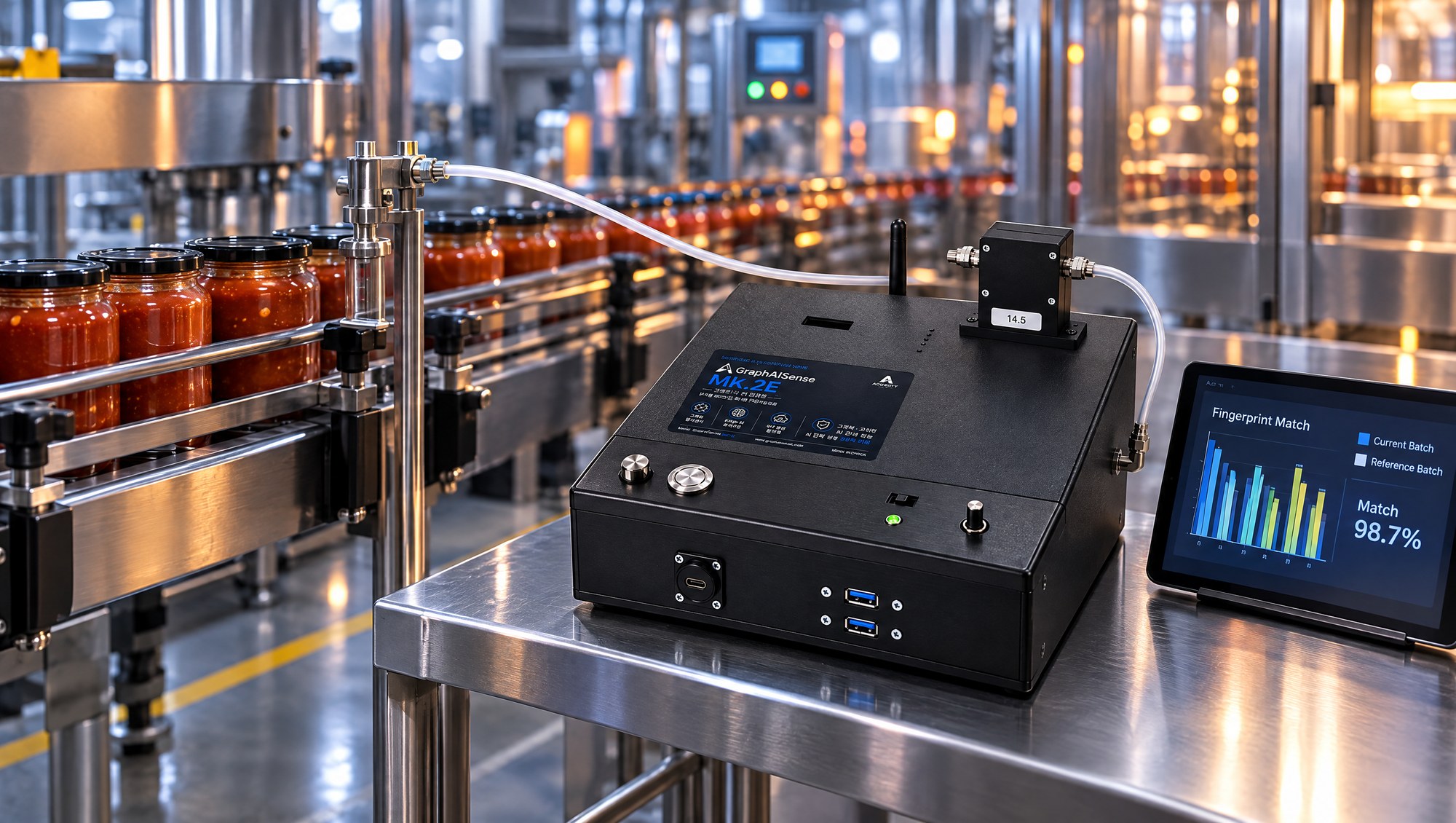
According to ADVENT’s technical data cited in the report, the Mk.2E was trained on three commercial perfumes and then re-identified separate measurements with per-product classification accuracy of 98.78–100% in that test. The partners are reviewing a scent data centre for perfume and cosmetics, links to IP protection, and environmental odour monitoring services.
Figures are ADVENT’s own test results under the stated conditions, not a general accuracy claim.
Source: The Power
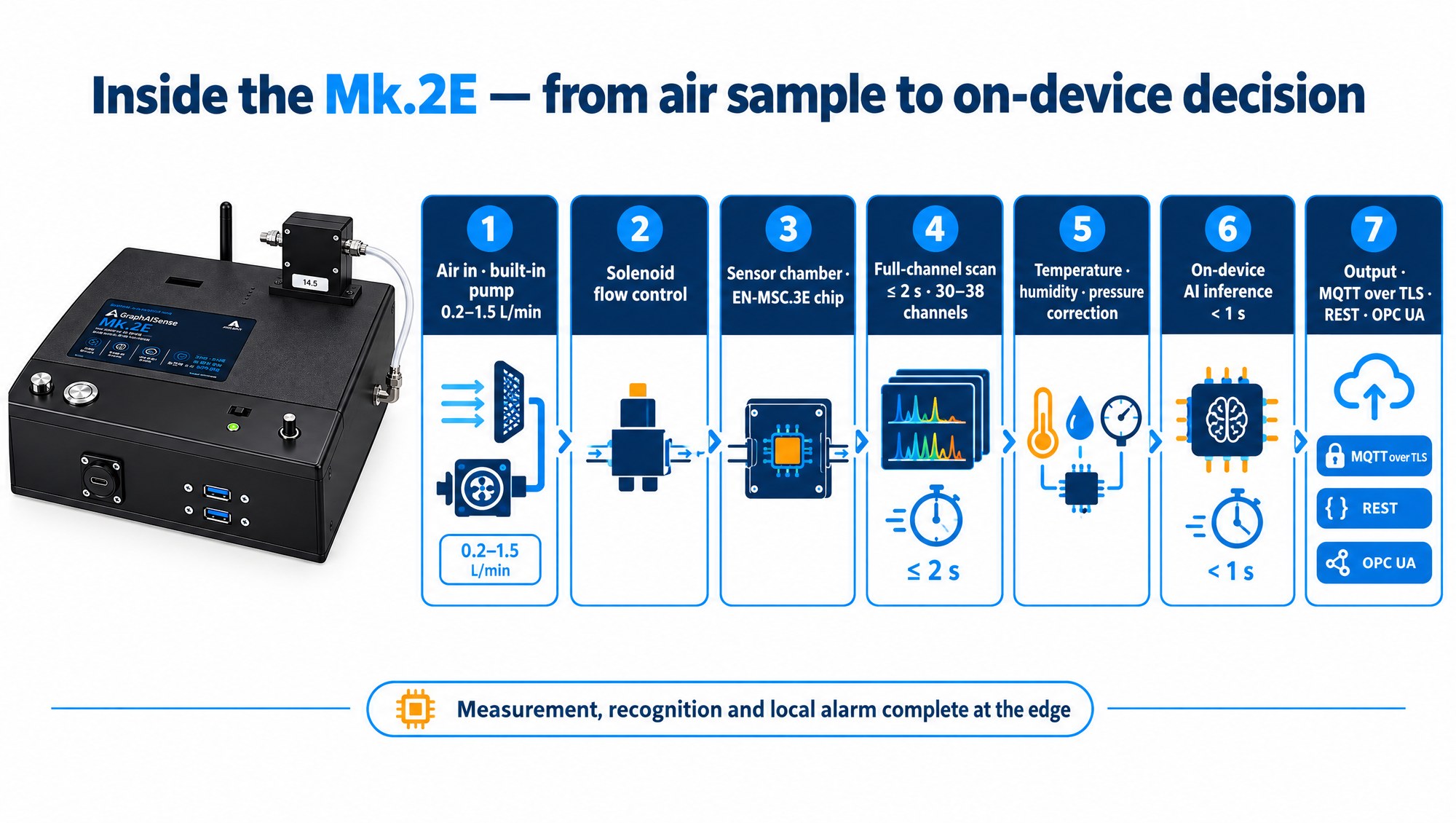
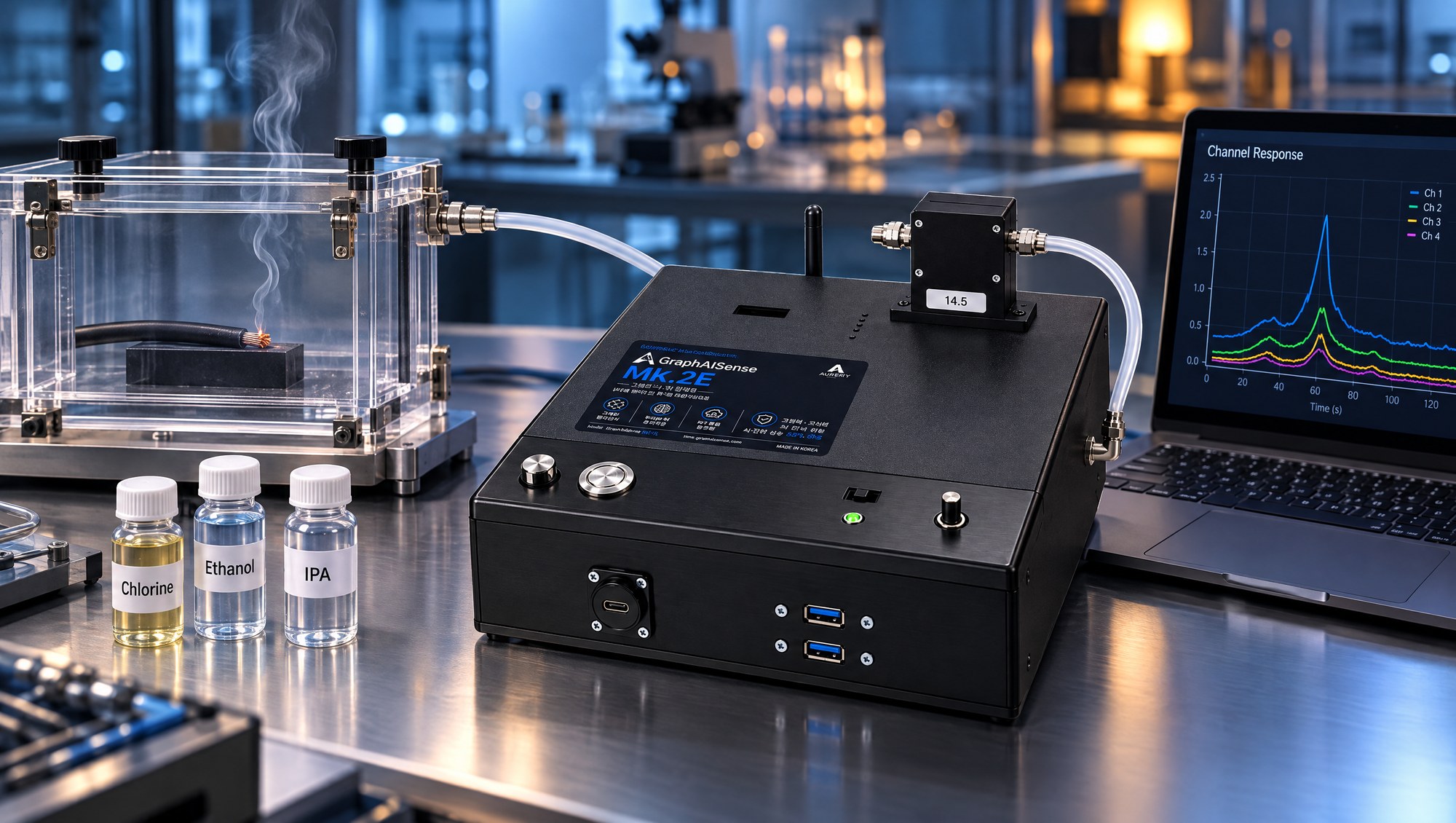
The Mk.2E reads a mixture across 30 to 38 channels on a cycle of two seconds or less, and runs its Model Pack on the instrument itself in under a second.
GraphAISense Mk.2E is ADVENT’s shipping graphene AI electronic nose. It is built around the EN-MSC.3E multisensor chip — aminated graphene functionalised with peptide receptors — and reads an odour as a pattern across 30 to 38 active channels rather than as a single concentration number.
270 × 250 × 90 mm, AC 220 V, 75 W max, optional backup battery of 8 hours or more.
Because inference runs on the instrument, the raw signal does not have to leave the site to be useful — which is what makes restricted facilities reachable at all.
Performance figures are ADVENT’s own verification results under the stated conditions. They are not accredited third-party certificates and must not be generalized as overall accuracy.
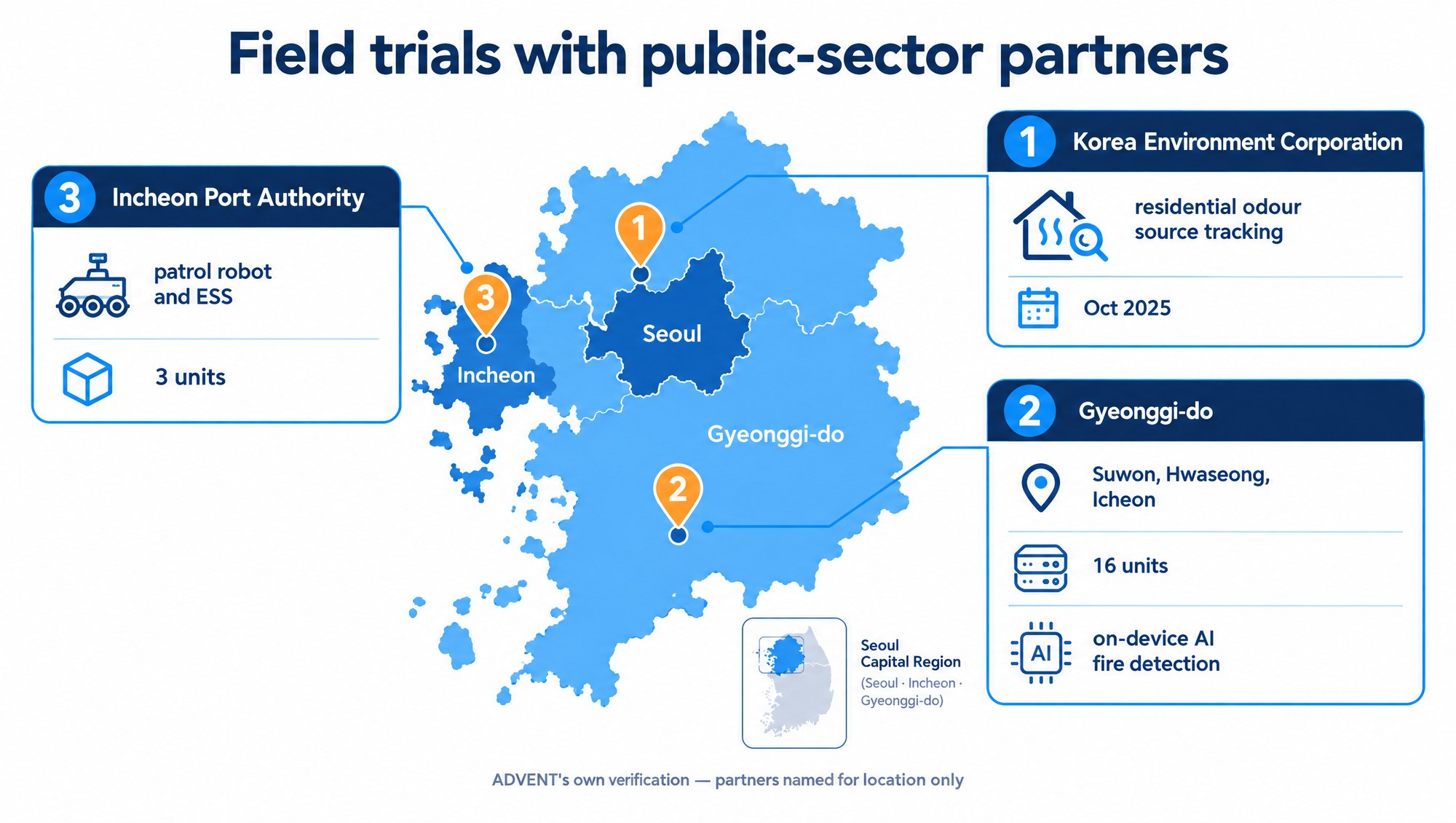
Gyeonggi-do will deploy AI CCTV, graphene e-nose sensors and Korean NPUs at industrial complexes, logistics sites and markets by 2027; ADVENT is a participating company.
Gyeonggi-do announced a KRW 9.8 billion programme, running to December 2027, to build an AI-based fire-safety network for high-risk sites in Suwon, Hwaseong and Icheon, including industrial complexes, logistics centres and traditional markets.
AI CCTV will watch for flame and smoke, while graphene e-nose sensors track changes in gases and other chemicals, with analysis on domestic AI chips at the edge. ADVENT is listed among the participating AI companies.
Source: Korea Land & Transport News

ADVENT is supplying graphene AI e-noses to a two-year on-device AI project that adds smell to CCTV and fire-fighting robots to catch fire precursors before smoke.
ADVENT has joined the consortium for the 2026 On-device AI Service Demonstration and Expansion programme, run by NIPA and led by Gyeonggi Technopark, with the cities of Suwon, Icheon and Hwaseong.
The project combines graphene AI e-noses, AI semiconductors, AI CCTV and integrated control to detect the VOCs and gases released before a fire becomes visible. It includes a scenario linking the e-nose with a fire-response robot at the Suwon resource recycling centre. Over two years, the consortium aims to build a field-proven reference model that can be rolled out nationwide.
Source: Nate News
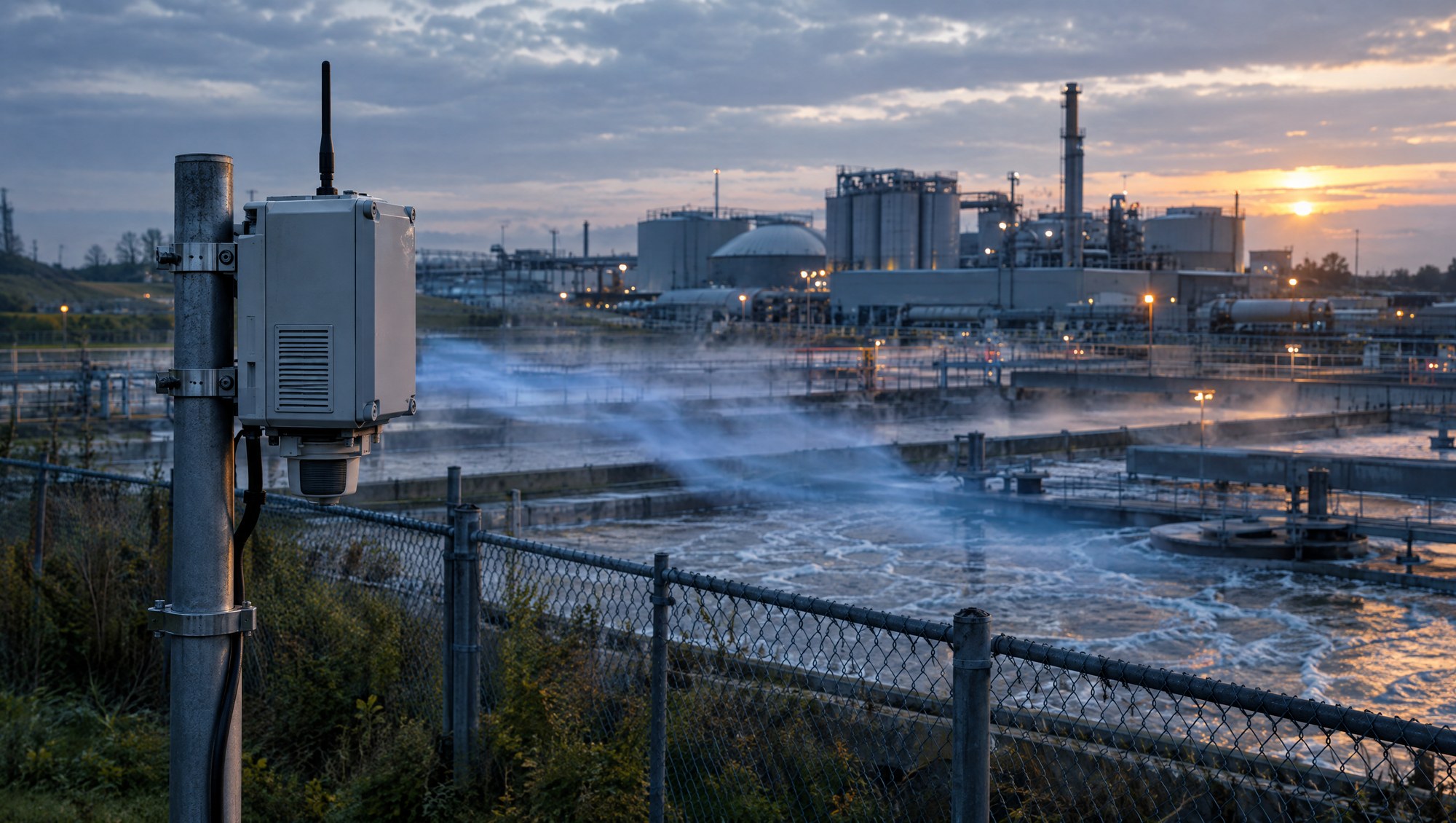
In a January 2026 in-house test, smouldering wire insulation was correctly identified across the test set while chlorine, ethanol and isopropyl alcohol were present as background chemicals.
Electrical fires announce themselves chemically before they announce themselves as smoke or heat. The question is whether an instrument can tell that chemistry apart from the ordinary background of an industrial room.
Smouldering wire insulation was set as the target. Chlorine, ethanol and isopropyl alcohol were introduced as background chemicals — three substances that a conventional single-point sensor has no way of separating from a genuine precursor. Across the test set, the target was correctly identified.
This is a scoped result. It says the instrument separated one target from three named interferents under the stated conditions. It is not a general accuracy figure, and it does not extend to substances that were not in the test.
This is ADVENT’s own verification result, not an accredited third-party test certificate. GraphAISense is a complementary monitoring channel; it does not replace statutory fire protection systems.
Speaking at the AX Forum in the National Assembly, ADVENT Vice President Baek In-yeol argued that robots need olfaction and proposed an olfactory AI data centre.
At the “AX Forum: a safer Korea with AI”, held at the National Assembly Members’ Office Building in Yeouido, ADVENT Vice President Baek In-yeol said that today’s robots cannot recognise chemical substances by smell, and that a robot without an AI nose is missing a sense.
He proposed building a dedicated olfactory AI data centre, noting that olfactory models improve as standardised smell data accumulates, and described ADVENT’s collaboration with Korea Environment Corporation.
Source: Nate News
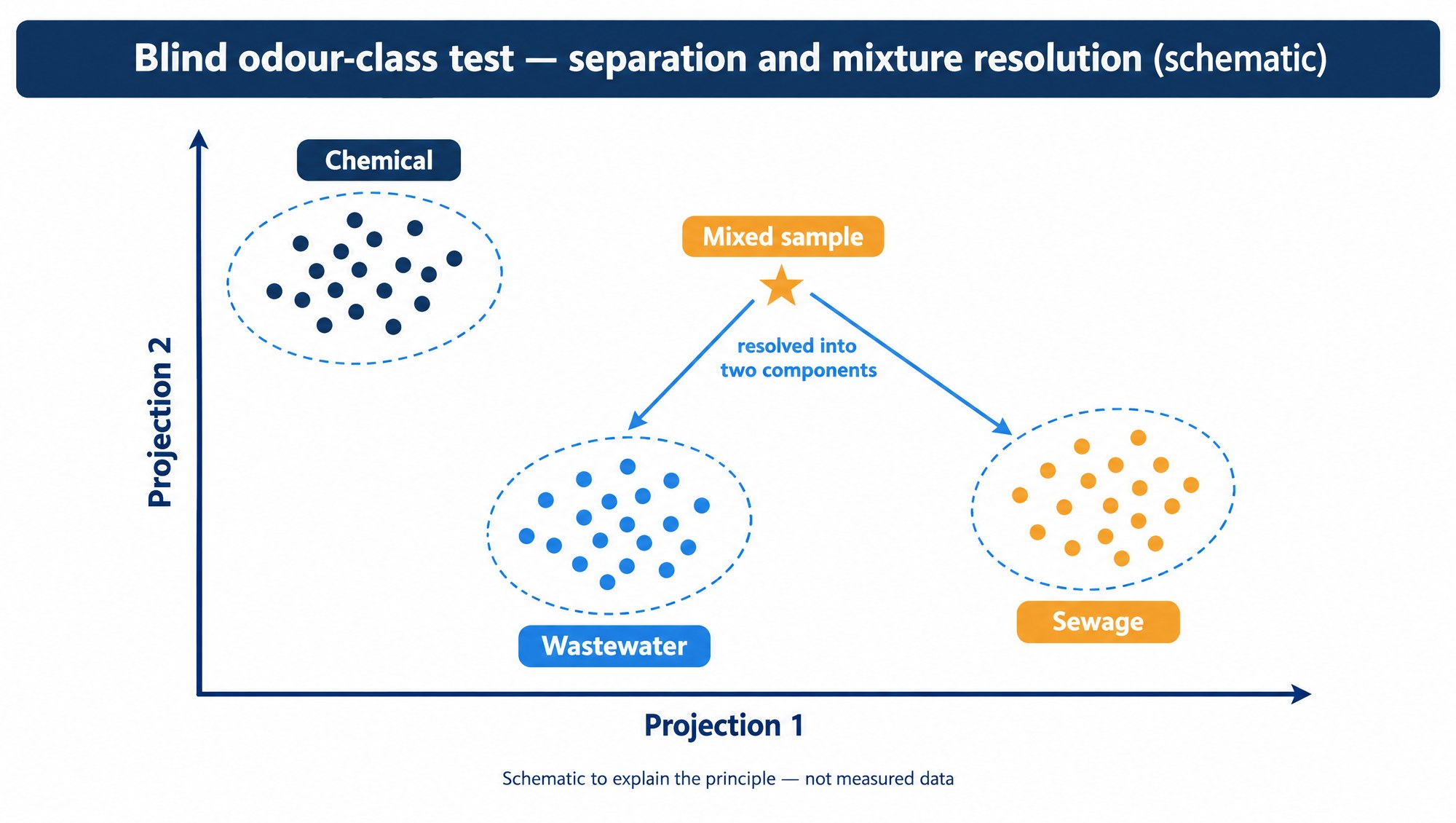
A blind test in Q4 2025 separated chemical, wastewater and sewage odour classes with high accuracy, and resolved a mixed sample into its two components.
Odour complaints are hard to act on because the complaint arrives as a description, not as a measurement. Separating classes of odour is the first step to making one actionable.
Chemical, wastewater and sewage odour classes were presented blind. The classes were separated with high accuracy, and a mixed sample was resolved into its two components — which matters, because real sites almost never present one odour at a time.
This is ADVENT’s own verification result under the stated conditions, not an accredited third-party test certificate, and it must not be generalized as an overall accuracy figure.
GraphAISense is collecting odour and VOC data in Tolyatti, Russia, storing each source as an olfactory fingerprint for complaint response and environmental policy.
ADVENT and the environmental research institute of Togliatti State University are operating a bus-based mobile air-quality station fitted with GraphAISense. The e-nose works alongside existing sensors to collect odours and volatile organic compounds in real time.
The collected data is digitised and stored as olfactory fingerprints, so that the source of a future odour complaint can be traced. The partners plan to review the system for formal city-wide monitoring after the test period ends in March 2026.
Source: G.ECONOMY
Korean media reported that ADVENT has commercialised GraphAISense, a graphene AI e-nose that collects odours and builds them into a searchable database.
ADVENT announced the commercialisation of GraphAISense, an aminated-graphene AI electronic nose and accompanying solution that records odours as data.
The report described an air-quality monitoring trial in Tolyatti, Russia, started in July 2025 with the city’s environmental research institute, where the e-nose runs alongside existing environmental sensors in a mobile monitoring vehicle to identify industrial and nuisance odours that conventional sensors miss.
Source: Nate News
ADVENT signed an MOU with the International Youth Environmental Federation to build e-nose based monitoring for hazardous environmental and defence sites.
ADVENT and the International Youth Environmental Federation signed a memorandum of understanding at ADVENT’s Seoul headquarters to jointly build an e-nose system for preventing and monitoring environmental and defence-related hazards.
Under the agreement, GraphAISense would be used to detect and analyse odour and gas data in real time at sensitive facilities, with applications ranging from septic-tank accident prevention and hazardous-gas detection to indoor air quality. The partners also plan to explore subscription-based services and collaborations with robot, drone and telecom companies.
Source: G.ECONOMY

We give AI the sense of smell.
GraphAISense is the product brand. ADVENT is the maker.
Headquarters #909, 28 Digital-ro 33-gil, Guro-gu, Seoul
R&D Center #420, 237 Yangji-ro, Sosa-gu, Bucheon-si, Gyeonggi-do
Plant 144-6, 3·1manse-ro 281beon-gil, Jangan-myeon, Hwaseong-si, Gyeonggi-do
ADVENT USA · US sales 8 The Green #22818, Dover, DE 19901, USA
Business registration 522-81-03199 · CEO Choi Chang-hee
Performance figures are ADVENT’s own verification results under the stated conditions; they are not accredited third-party certificates and must not be generalized as overall accuracy.
GraphAISense is a complementary monitoring channel. It does not replace statutory fire protection systems, legally mandated measuring instruments, or a battery management system.
Healthcare and care applications are at research stage. GraphAISense is not a diagnostic product.